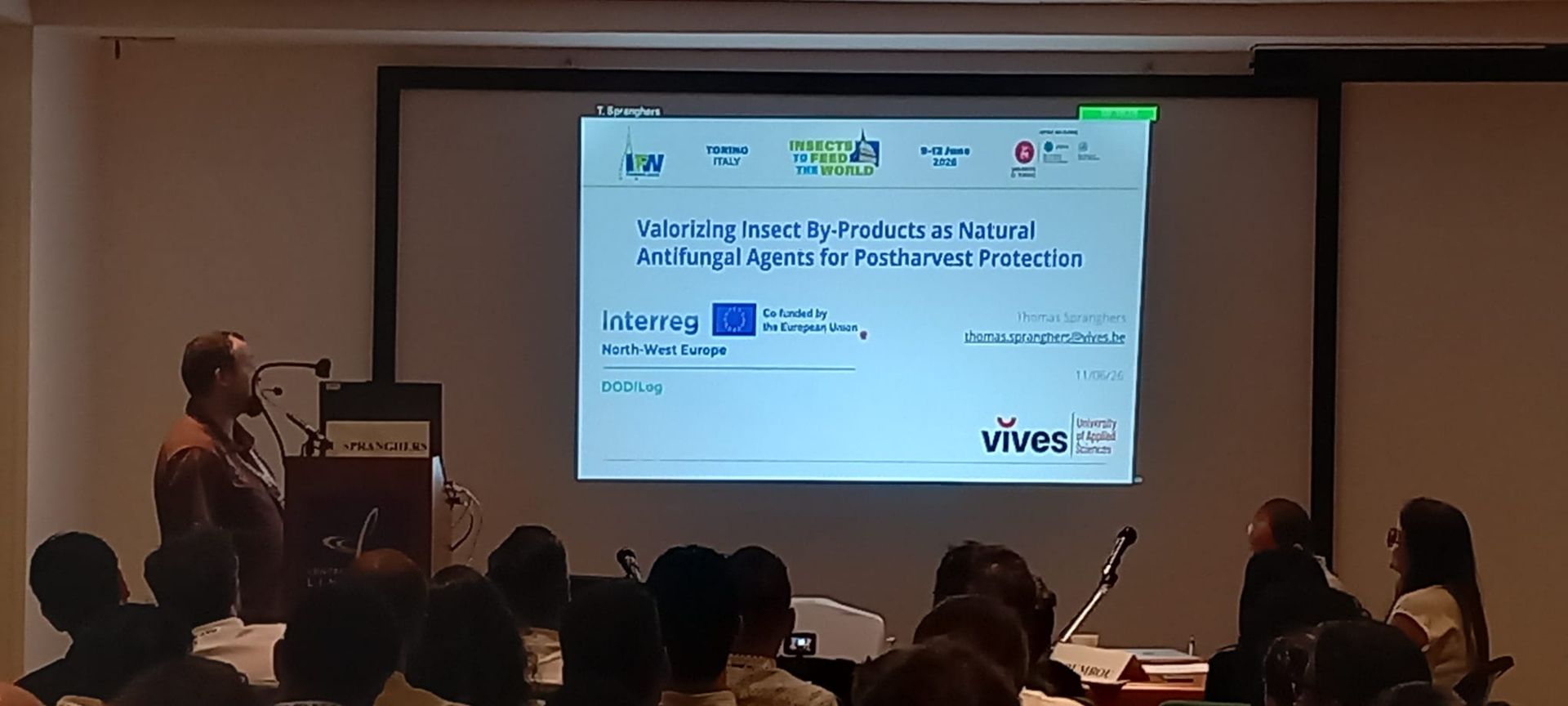
On 11 June, Thomas Spranghers, Senior researcher and teacher at Vives University College, DODILog partner, presented Vives and Inagro teams´ work on how insect by-producs can be used as natural anti-fungal agents for potateos post-harvest protection at the Insects to Feed the World - IFW international conference 2026 that took place in Turin, Italy. The speech was hosted during the Session “IMPACT AND APPLICATIONS OF INSECT-DERIVED PRODUCTS".
Thomas shared with the audience the findings of his tests on the potential exploitability of insect‑derived bioactive components to reduce storage losses in agricultural value chains, with a particular focus on suppressing Fusarium growth in potatoes. As part of the INTERREG DODILog project , unavoidable waste streams from Black Soldier Fly (Hermetia illucens) and mealworm (Tenebrio molitor) production were characterized and evaluated for their natural antifungal properties.
The piloting and validation showed that insect residues -and in particularly pupal shells due to their ~25 g/100 g chitin and high antioxidant capacity- represent a promising, circular source of natural antifungal compounds. Fermented extracts and peptides can suppress Fusarium, with the strongest effects observed in undiluted fractions. Future work will optimize extraction, concentration requirements for spray applications, and scalability within agricultural storage systems.
The work is part of the DODILog wider Business Case on how to optimise and valorise crops storage for potatoes.
Abstract IFW Thomas Sprangers "Valorizing Insect By‑Products as Natural Antifungal Agents for Postharvest Protection"
Note: IFW is the premier academic and industry conference of the insect farming industry for both insect as food and insect as feed. Previous editions took place in Wageningen (The Netherlands) in 2014, Wuhan (China) in 2018, Quebeq (2022), Singapore in 2024.

